Step 3 | One Ounce Trading
One Ounce Trading · Bullion education · Step 3
Which Precious Metals
Should I Buy?
Start with the right product for your goal.Find your buyer type
What Type of Buyer Are You?
Beginner / Stacker / Investor / Collector
Start With the Right Product for Your Goal
Once you have decided that you want to own physical gold or silver, the next question is usually:
“What should I actually buy?”
A gold bar?
A silver coin?
A round?
A small 1 gram gold bar?
A 1 oz silver stacker?
Or a limited-edition collectible?
There are thousands of bullion products available around the world, and for a first-time buyer the choices can feel overwhelming.
At One Ounce Trading, we believe the easiest way to choose is to begin with your purpose.
Are you buying primarily to:
- preserve wealth?
- accumulate ounces?
- diversify your savings?
- collect beautiful or limited pieces?
- or do a combination of all of these?
Once you know your goal, choosing the right product becomes much easier.
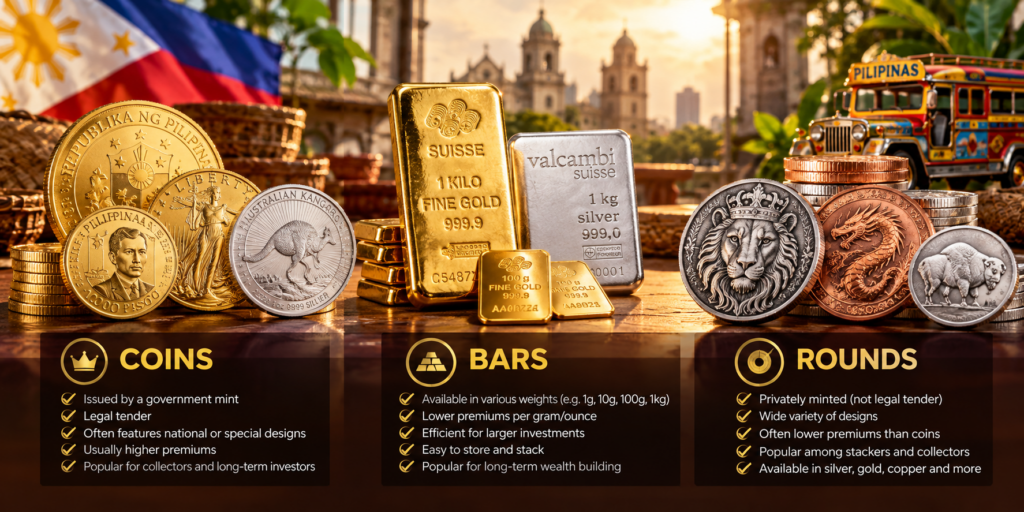
Bars, Coins and Rounds: What’s the Difference?
Gold and silver are commonly sold in three forms:
Bars
Bars are usually the simplest form of physical bullion.
They are produced by sovereign mints and private refiners in sizes ranging from tiny fractional gold bars to large silver and gold bars.
Bars are often ideal for buyers who want to focus on:
- Metal value
- Purity
- Compact storage
- Lower premiums
- Simple accumulation
For gold buyers in the Philippines, smaller bars such as 1 gram, 2.5 gram, 5 gram and 10 gram sizes can make starting more accessible.
Larger bars can become more efficient for buyers who want to store more value in fewer pieces.
The source material similarly identifies bars as particularly useful for buyers wanting to store substantial value in a compact format.
Best suited for:
Investors • Savers • Gold buyers • Long-term holders
Coins
Coins are usually issued by government or sovereign mints.
Popular examples around the world include:
- Australian Kangaroos
- Canadian Maple Leafs
- Britannias
- American Eagles
- Mexican Libertads
- Austrian Philharmonics
- South African Krugerrands
Many sovereign bullion coins have a stated face value, but their actual market value is determined largely by their metal content, international precious-metal prices and market premium.
Coins are popular because they combine:
- Recognised purity
- Established mints
- Global recognition
- Security features
- Potential resale familiarity
The source notes that sovereign-minted coins are particularly attractive because of recognised quality, government backing and established international recognition.
Best suited for:
Beginners • Investors • Stackers • Collectors
For a new Filipino bullion buyer who wants to keep things simple, a recognised 1 oz silver bullion coin can be one of the easiest products to understand.
Rounds
Rounds look very similar to coins.
The main difference is that they are normally produced by private mints rather than governments and are not legal tender.
That does not mean they are inferior.
Well-known private mints manufacture highly respected gold and silver products around the world.
Rounds can sometimes provide an economical way of accumulating silver because the buyer is paying primarily for the metal rather than a government-issued denomination.
The source likewise explains that rounds can provide a lower-premium option, although premiums vary and sometimes overlap with sovereign coins.
Best suited for:
Stackers • Value-focused buyers • Buyers accumulating ounces
Sovereign Mint or Private Mint?
This is another question beginners often encounter.
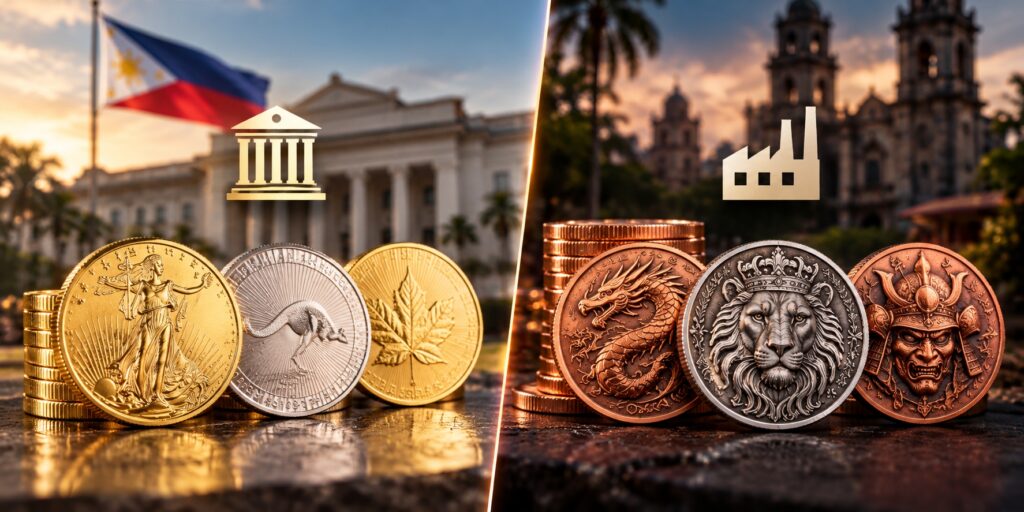
Sovereign Mints
A sovereign mint is operated by, owned by, or authorised by a government.
Examples include:
- The Perth Mint
- Royal Canadian Mint
- The Royal Mint
- United States Mint
- Austrian Mint
- South African Mint
- Mexican Mint
Products from major sovereign mints can be attractive because they are widely recognised and often incorporate sophisticated security features.
That recognition can also help when eventually selling or trading the bullion.
The source specifically notes that established sovereign-mint products can offer greater recognition and potential liquidity.
Private Mints
Private mints are commercial manufacturers rather than government institutions.
Some of the most respected names in the bullion industry are private refiners or mints.
Examples include:
- PAMP Suisse
- Valcambi
- Scottsdale Mint
- Germania Mint
- Asahi Refining
- Sunshine Minting
Private mints often provide:
- more designs
- different sizes
- innovative products
- stackable formats
- competitive premiums
For example, the Scottsdale stacker products popular with One Ounce customers combine physical silver ownership with a distinctive interlocking design.
The important point is not simply whether a product comes from a government or private mint.
What matters is the reputation of the manufacturer, stated purity, authenticity and price.
Bullion or Collectible?
This is one of the most important distinctions for One Ounce Trading customers.
Not every coin should be evaluated in exactly the same way.
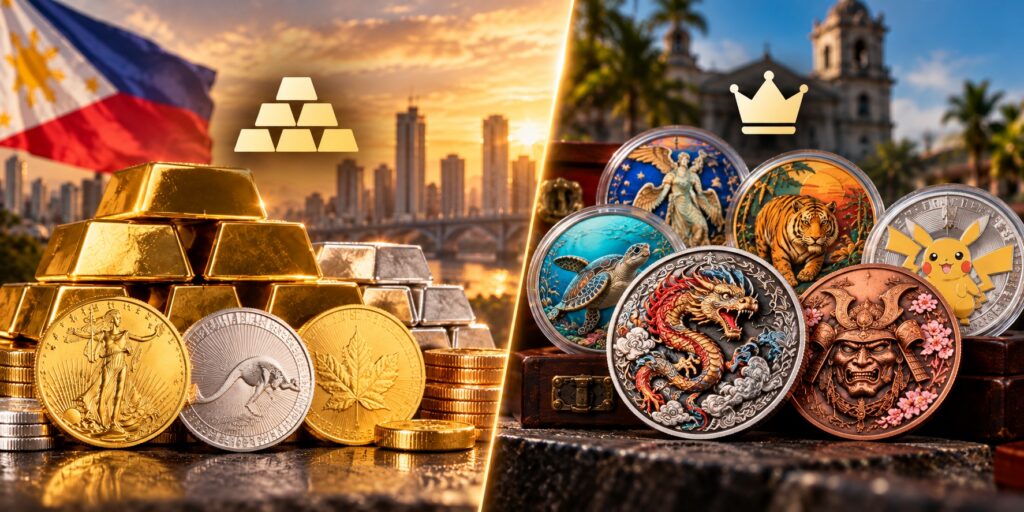
Bullion
Bullion products are purchased primarily for their metal content.
A bullion buyer normally focuses on:
- Weight
- Purity
- Spot price
- Premium
- Manufacturer
- Liquidity
For example, a standard 1 oz silver round containing .999 fine silver is primarily valued because of the ounce of silver it contains.
These products are generally suited to investors and stackers.
The source explains that standard bullion tends to offer lower spreads and can be easier to value when selling than highly collectible pieces.
Collectibles
A collectible can carry value beyond its metal content.
Why?
Because buyers may also value:
- Limited mintage
- Artwork
- Series
- Theme
- Historical significance
- Packaging
- Condition
- Rarity
You may therefore find two coins containing exactly 1 oz of silver but selling at very different prices.
One might be a standard bullion coin.
The other could be a limited-mintage release with specialised packaging.
That additional amount above the underlying metal value is part of the premium.
What Is a Premium?
This is something every new bullion buyer should understand.
The international market price of the metal is often called the:
Spot Price
But you normally cannot purchase a finished physical coin or bar exactly at spot price.
The final retail price usually includes a premium.
That premium can help cover:
- manufacturing
- minting
- refining
- international freight
- insurance
- import and logistics costs
- dealer costs
- supply and demand
For collectible products, the premium may also reflect:
- rarity
- mintage
- design
- brand
- market demand
The source makes the same distinction: the final price consists of the base metal price plus a premium, and premiums can rise when a product becomes scarce or highly sought after.
This is why you should never compare bullion products by price alone.
Ask:
How much metal am I getting?
and
What am I paying the extra premium for?
Investment Bullion vs Semi-Numismatic
Some products sit between ordinary bullion and traditional collectibles.
These are often called:
Semi-Numismatic
They contain investment-grade precious metal but may also attract additional demand because of:
- limited mintage
- annual designs
- popular series
- scarcity
- collector interest
Examples might include selected releases from:
- Perth Mint Lunar Series
- Kookaburra Series
- Libertads
- limited Scottsdale releases
- special Germania products
These products can sometimes develop higher premiums in the secondary market.
But that is not guaranteed.
A collector premium can increase.
It can also decrease.
So someone purchasing primarily for investment should understand how much of the price represents metal and how much represents collectibility.
Troy Ounces vs Grams
You will constantly see these measurements when shopping for bullion.
1 Troy Ounce = Approximately 31.1035 Grams
The troy ounce is the international standard used for precious metals.
It is different from the normal household ounce.
When you see international gold or silver spot prices, they are generally quoted per troy ounce.
The source confirms that 1 troy ounce equals approximately 31.1034768 grams and that troy ounces are the standard unit used throughout much of the precious-metals market.
Why Are Small Gold Bars Sold in Grams?
A full troy ounce of gold can represent a substantial amount of money.
Fractional bars allow people to start with a smaller budget.
That is why you commonly see:
- 1 gram
- 2.5 gram
- 5 gram
- 10 gram
- 20 gram
gold products.
For many Filipino buyers, a 1 gram gold bar can be a practical introduction to owning physical gold without immediately committing to a full ounce.
Why Is 1 oz So Popular for Silver?
Silver has a lower price per ounce than gold.
This makes the 1 oz silver coin, round or bar one of the most accessible standard units for people starting a physical stack.
It is:
- easy to understand
- easy to count
- easy to compare
- widely available
- small enough to accumulate gradually
This also happens to reflect how many One Ounce customers shop.
Someone may begin with one piece.
Then another.
Then five.
Then a tube.
One ounce becomes the building block.
Which Product Is Best for a Beginner?
If your main objective is investing rather than collecting, simplicity is usually an advantage.
The source recommends recognised sovereign-mint coins and reputable private-mint bullion for new investors because they are easier to understand and generally more recognisable.
For a first purchase, we would generally suggest learning with products that have:
- Recognised purity
- Clear weight
- Established mint or manufacturer
- Reasonable premium
- Straightforward pricing
Examples might include:
Gold Beginner
1 gram or small minted gold bar
A lower entry point into physical gold.
Silver Beginner
1 oz bullion coin or round
An affordable way to learn about physical silver.
What Should a Stacker Buy?
A stacker’s objective is normally different from a collector’s.
Stackers typically ask:
“How many ounces can I accumulate efficiently?”
That means they tend to pay attention to:
- premium per ounce
- quantity discounts
- recognised products
- storage
- repeat availability
Products such as:
- 1 oz silver rounds
- stackable silver
- standard bars
- tubes of bullion coins
may therefore make more sense than expensive limited editions.
For a stacker, ounces matter.
What Should an Investor Buy?
An investor generally focuses on balancing:
- metal content
- premium
- recognition
- liquidity
- storage efficiency
Gold bars may appeal to someone who wants significant value in a compact form.
Silver bars, rounds and widely recognised bullion coins may appeal to someone looking to accumulate physical silver efficiently.
The objective is normally less about owning a particular design and more about building exposure to the underlying metal.
What Should a Collector Buy?
A collector asks different questions.
Instead of only asking:
“How much is silver today?”
they may ask:
- How many were minted?
- Is this the first release?
- Will the series continue?
- Is the packaging original?
- What year is it?
- How difficult is it to find?
For collectors, the enjoyment of owning something unusual can be just as important as the underlying metal.
That is why One Ounce Trading carries both bullion-focused products and special releases.
Investor, Stacker or Collector?
You don’t necessarily have to choose only one.
Many of our customers are a combination.
A customer may buy:
a 1 gram gold bar for saving
then:
a Scottsdale silver stacker for accumulation
and later:
a limited Lunar or Germania release for the collection
That is perfectly reasonable.
The important thing is understanding why you are buying each item.
What About Copper?
Copper is different.
Many of the copper products sold at One Ounce Trading are purchased mainly because customers appreciate:
- the artwork
- large physical format
- affordable entry price
- limited designs
- collectibility
Copper rounds can be a fun and accessible way to enter the world of physical metals and collecting.
But they should not automatically be treated the same way as investment-grade gold or silver bullion.
What Filipino Buyers Should Check Before Ordering
Before buying any bullion product, consider:
1. Weight
Is it 1 gram?
5 grams?
1 troy ounce?
5 ounces?
1 kilogram?
2. Purity
Typical examples include:
- 999.9 gold
- .999 silver
- .9999 silver
3. Mint or Manufacturer
Is the producer recognised?
4. Premium
How much are you paying above the underlying metal value?
5. Purpose
Are you buying it to:
- invest
- stack
- save
- collect?
6. Availability
Is it:
- On Hand
- Pre-Order
- Limited Stock
- Sold Out?
7. Total Cost
Don’t look only at the product price.
Also consider:
- shipping
- insurance
- payment method
- storage
These practical questions matter because they are exactly where new buyers tend to need reassurance.
On Hand or Pre-Order?
This is particularly relevant in the Philippine bullion market.
Not every international bullion release is immediately available locally.
On Hand
The product is already physically available from the seller and can generally be prepared for pickup or shipping after payment and processing.
Pre-Order
The item has been reserved before it arrives.
Pre-ordering can help customers secure:
- new releases
- limited mintages
- popular designs
- products that may sell out internationally
But buyers should always check the expected arrival period and understand that international shipping and logistics can affect delivery dates.
Authenticity Matters
When buying bullion, price should not be the only consideration.
You should also consider:
- where the item came from
- who produced it
- whether the dealer is established
- whether the specifications are clearly disclosed
A suspiciously cheap gold bar is not a bargain if you cannot trust what is inside it.
Buy the product — but also buy confidence in the source.
Our Simple Guide
If you’re still unsure, start here:
BEGINNER
- Recognised 1 oz silver bullion
- Small gold bars
- Simple products
- Reasonable premiums
STACKER
- Low-premium silver
- Rounds
- Stackers
- Bars
- Tubes
- Quantity purchases
INVESTOR
- Recognised gold and silver
- Larger bars
- Efficient premiums
- Globally recognised brands
COLLECTOR
- Limited mintages
- Special editions
- Series
- High-relief pieces
- Unique designs
The One Ounce Trading Approach
At One Ounce Trading, we don’t believe every customer should buy the same product.
Someone buying their first 1 oz silver coin has different needs from someone ordering ten pieces of a limited release.
A buyer building a long-term gold holding has different priorities from someone completing a Lunar series.
Our goal is to make those differences easier to understand.
Know what you’re buying.
Know why you’re buying it.
Understand the premium.
Start with what fits your budget.
And build from there.
Start With One.
One Ounce Trading
Your Trusted Bullion Store
Gold • Silver • Copper
For Beginners • Stackers • Investors • Collectors
Educational information only. Precious-metal prices and collectible premiums can rise or fall. One Ounce Trading does not provide personalised financial advice.